At HOLLEN CZ s. r. o., we are continuously advancing AI-driven analytics for defect detection. ur systems are now learning to recognize complex visual and structural defects directly from camera data—autonomously and in real time.
The project “Autonomous AI-driven analytics of visual and structural defects based on camera data” is co-funded by the Applications Programme – Call II.
Why speed alone is no longer enough today
In industrial manufacturing, speed alone is no longer sufficient. Accuracy, reliability, and the ability to detect defects before they reach the customer are equally important. This is exactly the principle behind the HOLLEN CZ project, which is developing an autonomous AI system for the analysis of visual and structural defects using camera data.
Intelligent quality control in practice
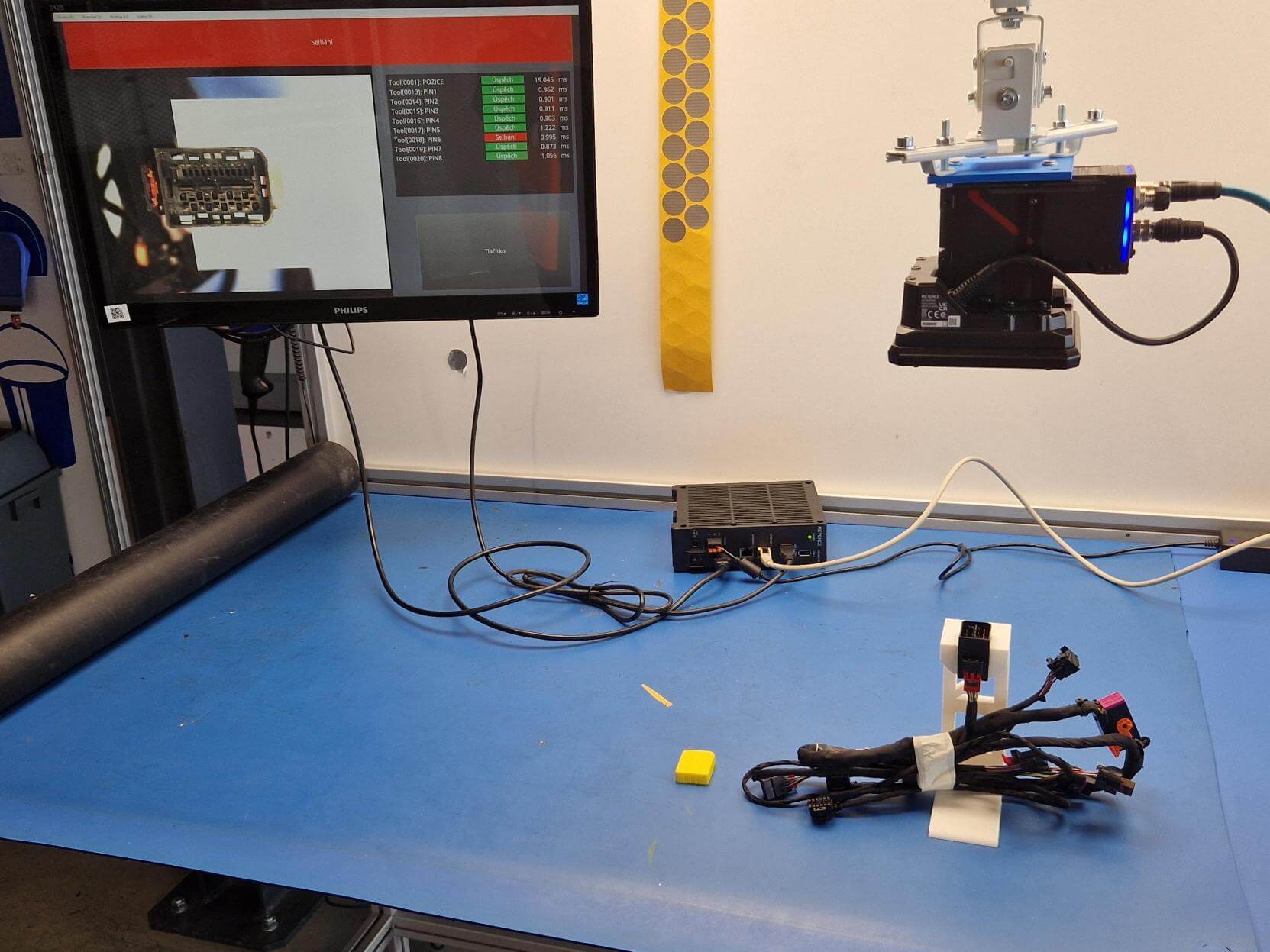
The aim of the solution is to replace time-consuming and error-prone manual inspection with an intelligent system capable of identifying missing components, incorrectly assembled parts, or surface defects in real time. The project is designed to be integrated into existing enterprise systems while supporting the digitalization of manufacturing and inspection processes.
Benefits for the automotive industry and manufacturing
The project also responds to the needs of the demanding automotive environment, where the pressure on quality and process stability is extremely high. Its goal is to gradually reduce the error rate of visual inspection and speed up the entire process compared to manual verification. The expected benefits include a reduction in the number of complaints, more efficient responses to production issues, and an overall strengthening of customer trust.
A major advantage is that the system does not rely on a simple camera alone. It leverages a combination of artificial intelligence, machine learning, edge computing, and data analytics, enabling image processing directly at the workplace while sending only results and metadata to the central system. This reduces data load, speeds up response times, and increases the overall efficiency of the process.
It is also worth noting that the project is not only about technology, but also about processes. The development includes testing in real conditions, setting up inspection procedures, working with lighting, camera calibration, and preparing training data for the AI model. In practice, this means the final solution is designed to be not only modern, but also practical and stable for everyday manufacturing.
The future of quality control
This project demonstrates how artificial intelligence can support quality control in areas where the human eye is no longer sufficient or is too slow. It represents a step toward intelligent manufacturing that is more accurate, faster, and better prepared for future industry demands.